Shipping
Supply chain
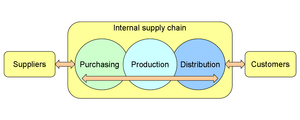
A supply chain is a system of organizations, people, technology, activities, information and resources involved in moving a product or service from supplier tocustomer. Supply chain activities transform natural resources, raw materials and components into a finished product that is delivered to the end customer. In sophisticated supply chain systems, used products may re-enter the supply chain at any point where residual value is recyclable. Supply chains link value chains
![]()
http://www.youtube.com/watch?v=OaxJ4oEuBO8
Supply chain management
In the 1980s, the term Supply Chain Management (SCM) was developed[5] to express the need to integrate the key business processes, from end user through original suppliers. Original suppliers being those that provide products, services and information that add value for customers and other stakeholders. The basic idea behind the SCM is that companies and corporations involve themselves in a supply chain by exchanging information regarding market fluctuations and production capabilities.
http://www.youtube.com/watch?v=Mi1QBxVjZAw
Supply chain modeling
The SCOR Supply-Chain Operations Reference model, developed by the Supply Chain Council, measures total supply chain performance. It is a process reference model for supply-chain management, spanning from the supplier's supplier to the customer's customer.[3] It includes delivery and order fulfillment performance, production flexibility, warranty and returns processing costs, inventory and asset turns, and other factors in evaluating the overall effective performance of a supply chain.
http://www.youtube.com/watch?v=z5fUvdfPp6I
Fourth-party logistics
The concept of Fourth-Party Logistics (4PL) provider was first defined by Andersen Consulting (Now Accenture) as an integrator that assembles the resources, capabilities and technology of its own organization and other organizations to design, build, and run comprehensive supply chain solutions. Whereas a third party logistics (3PL) service provider targets a function, a 4PL targets management of the entire process. Some have described a 4PL as a general contractor who manages other 3PLs, truckers, forwarders, custom house agents, and others, essentially taking responsibility of a complete process for the customer
Third-party logistics
Third-party logistics (3PL) involves using external organizations to execute logistics activities that have traditionally been performed within an organization itself.[3] According to this definition, third-party logistics includes any form of outsourcing of logistics activities previously performed in-house. If, for example, a company with its own warehousing facilities decides to employ external transportation, this would be an example of third-party logistics. Logistics is an emerging business area in many countries.
http://www.youtube.com/watch?v=KsF4fEAHO_g&playnext=1&list=PL2ACC80EA4FE38D23&index=12
Warehouse management systems and warehouse control systems
Although there is some functionality overlap, the differences between warehouse management systems (WMS) and warehouse control systems (WCS) can be significant. Simply put, a WMS plans a weekly activity forecast based on such factors as statistics and trends, whereas a WCS acts like a floor supervisor, working in real time to get the job done by the most effective means. For instance, a WMS can tell the system it is going to need five of stock-keeping unit (SKU) A and five of SKU B hours in advance, but by the time it acts, other considerations may have come into play or there could be a logjam on a conveyor. A WCS can prevent that problem by working in real time and adapting to the situation by making a last-minute decision based on current activity and operational status. Working synergistically, WMS and WCS can resolve these issues and maximize efficiency for companies that rely on the effective operation of their warehouse or distribution center
http://www.youtube.com/watch?v=9VR1uT6jr4E
Logistics management
- Materials Management
- Channel Management
- Distribution (or Physical Distribution)
- Business or Logistics Management or
- Supply Chain Management
types of logistics
Military logistics In military science, maintaining one's supply lines while disrupting those of the enemy is a crucial—some would say the most crucial—element of military strategy, since an armed force without resources and transportation is defenseless. The defeat of the British in theAmerican War of Independence and the defeat of the Axis in the African theatre of World War II are attributed to logistical failure.The historical leaders Hannibal Barca, Alexander the Great, and the Duke of Wellington are considered to have been logistical geniuses.
Business logistics Logistics as a business concept evolved in the 1950s due to the increasing complexity of supplying businesses with materials and shipping out products in an increasingly globalized supply chain, leading to a call for experts called supply chain logisticians. Business logistics can be defined as "having the right item in the right quantity at the right time at the right place for the right price in the right condition to the right customer", and is the science of process and incorporates all industry sectors. The goal of logistics work is to manage the fruition of project life cycles, supply chains and resultant efficiencie
Production logistics The term production logistics is used to describe logistic processes within an industry. The purpose of production logistics is to ensure that each machine and workstation is being fed with the right product in the right quantity and quality at the right time. The concern is not the transportation itself, but to streamline and control the flow through value-adding processes and eliminate non–value-adding ones. Production logistics can be applied to existing as well as new plants. Manufacturing in an existing plant is a constantly changing process. Machines are exchanged and new ones added, which gives the opportunity to improve the production logistics system accordingly. Production logistics provides the means to achieve customer response and capital efficiency.
what is logistics
http://www.youtube.com/watch?v=UWqfLtiYJYc&feature=relatedLogistics is the management of the flow of the goods, information and other resources in a repair cycle between the point of origin and the point of consumption in order to meet the requirements of customers. Logistics involves the integration of information, transportation, inventory,warehousing, material handling, and packaging, and occasionally security. Logistics is a channel of the supply chain which adds the value of time and place utility. Today the complexity of production logistics can be modeled, analyzed, visualized and optimized by plant simulation software.http://www.youtube.com/watch?v=UWqfLtiYJYc&feature=related